I'm Still Rolling Podcast Episodes: A Journalistic Guide to Resilience
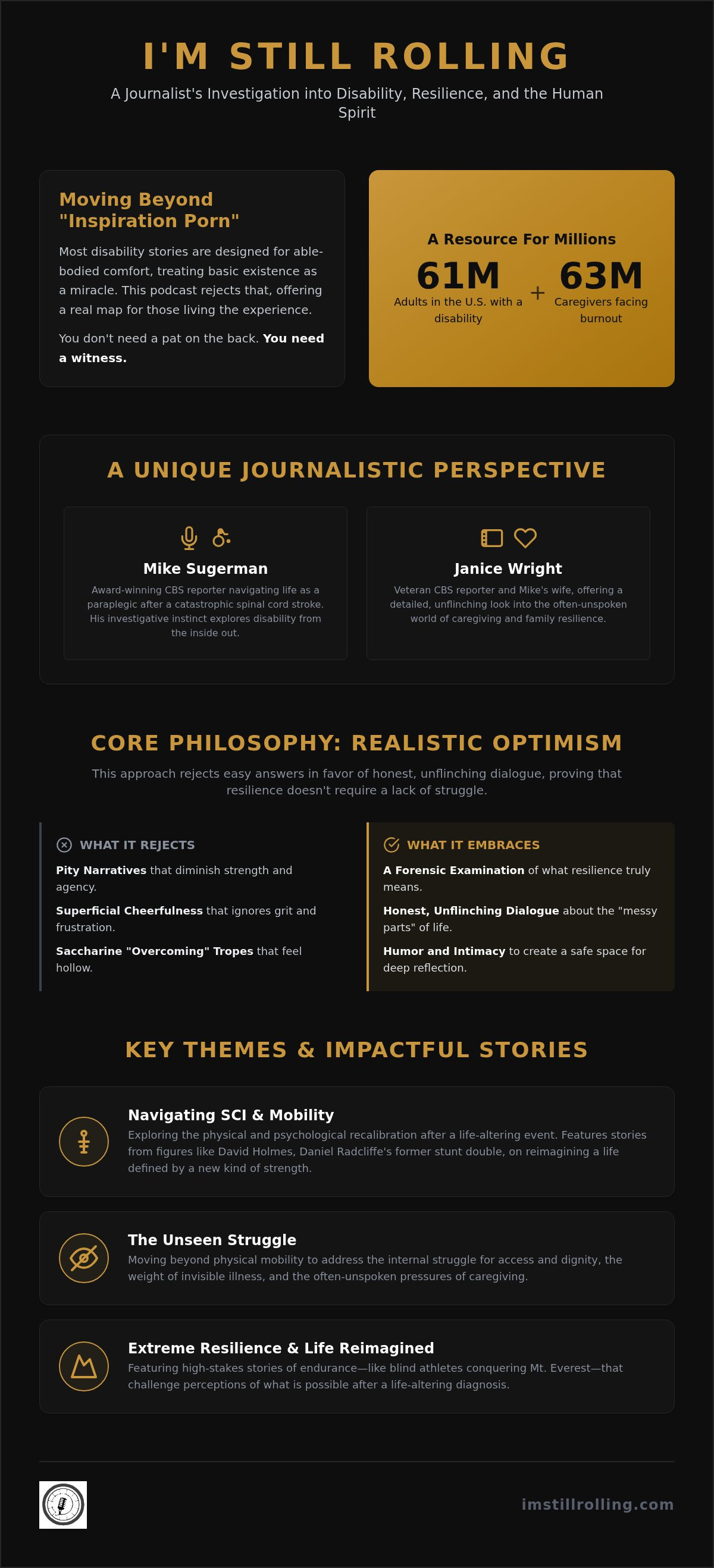
Most stories about disability are designed to make the able-bodied feel comfortable, yet they rarely offer a map for those actually living the experience. You likely recognize the hollow ring of "inspiration porn" that treats basic existence as a miracle while ignoring the grit it takes to get through the day. If you are among the 61 million adults in the U.S. living with a disability, or the 63 million caregivers facing burnout, you don't need a pat on the back. You need a witness. This is why I'm Still Rolling Podcast Episodes provide more than just conversation; they offer a journalistic investigation into the human spirit. Hosted by Mike Sugerman and Janice Wright, two award-winning CBS reporters, this series brings a professional lens to the messy, unflinching reality of life after a spinal cord stroke.
It's a perspective that acknowledges the gravity of hardship without surrendering to it. You deserve a community that understands the nuances of mobility aids and the weight of invisible illness. In this guide, we'll preview the most impactful stories from their archive, showing you how to find strength in shared experience and practical wisdom for the road ahead. We are moving past superficial cheerfulness to find a grounded, realistic optimism together.
Table of Contents
The Journalistic Origin of the I'm Still Rolling Podcast
For over four decades, Mike Sugerman and Janice Wright were the voices and faces of CBS News, reporting on the complexities of the human condition with professional detachment. That detachment vanished in an instant. The "Cement Mixer" moment, as they call it, arrived when Mike suffered a catastrophic stroke that left him a paraplegic. Their world didn't just change; it was pulverized and reconstructed into a new, unfamiliar reality. Instead of retreating, they did what journalists do: they started asking questions. I'm Still Rolling Podcast Episodes are the result of that inquiry, blending high-level broadcast reporting with the raw, unfiltered intimacy of two people navigating a life they never planned for.
This isn't a show about "overcoming" in the traditional, saccharine sense. It is a forensic examination of resilience. By applying journalistic rigor to the experience of disability, Mike and Janice move beyond the surface-level tropes often found in media. They understand that while a Spinal Cord Injury changes the body, the struggle to maintain one's identity is a much deeper story. The podcast thrives on a dual-host dynamic that balances Mike's perspective as a survivor with Janice's lived experience as a caregiver, ensuring that neither side of the equation is ignored.
From CBS News to the World of Disability
Mike Sugerman's legacy as a storyteller was built on finding the extraordinary in the ordinary. Before his stroke, he was the one holding the microphone, guiding audiences through the lives of others. Today, he uses that same investigative instinct to explore his own limitations and the triumphs of his guests. His background allows him to cut through the clinical jargon of recovery to find the heartbeat of a story.
Janice Wright's transition was equally profound. She shifted from reporting the news to managing a complex medical crisis, yet she never lost her reporter’s eye for detail. Together, they use their "press passes" to provide a backstage pass to the world of disability. Their professional history gives them unique access to extraordinary guests who might otherwise remain silent, allowing them to bring high-stakes journalism to a community that is often overlooked or patronized.
The Philosophy of Realistic Optimism
The philosophy guiding every conversation is one of realistic optimism. This approach rejects the "pity" narrative in favor of honest, unflinching dialogue. They aren't afraid to explore the "messy" parts of life, from the frustration of inaccessible buildings to the quiet fatigue of a long-term caregiver. I'm Still Rolling Podcast Episodes use humor and intimacy to create a safe space for deep reflection, proving that resilience doesn't require a lack of struggle.
This podcast serves as a vital resource for those newly initiated into the world of mobility aids or invisible illness. It offers a grounded, soulful connection that feels both authoritative and deeply personal. By refusing to settle for superficial cheerfulness, Mike and Janice provide a roadmap for others to find meaning within their own struggles, proving that even when the wheels are rolling, the story is far from over.
Navigating the Physical Shift: Key Episodes on SCI and Mobility
The shift from a world of fluid movement to one of calculated logistics is a violent restructuring of reality. For many, this transition happens in a heartbeat, leaving the individual to navigate a body that no longer follows the mind's commands. I'm Still Rolling Podcast Episodes serve as a vital archive for these moments of sudden transformation, offering a deep dive into the physical and psychological recalibration required after a life-altering event. This isn't just about the mechanics of a wheelchair; it's about the internal architecture of a new life.
Stories of Sudden Transformation
In Season 5 Episode 1, the show introduces us to David Holmes, the former stunt double for Daniel Radcliffe in the Harry Potter series. Holmes went from performing high-stakes Quidditch stunts to living as a paraplegic after a rehearsal accident. His story is a masterclass in realistic optimism. He discusses the transition from a career defined by physical prowess to a life defined by a different kind of strength, proving that while the body may be restricted, the spirit remains unyielding.
Mike Sugerman’s own journey mirrors this sudden shift. He often recounts the disorienting first days after his post-surgical stroke, a period where the professional reporter had to become the subject of his own investigation. The first six months of disability are often the most harrowing, as one moves from the sterile environment of a hospital to the practical hurdles of a "new normal." Accessing reliable Spinal Cord Injury Information is a crucial first step, but hearing the lived experiences of those who have survived that initial shock provides a level of comfort that clinical data cannot match.
The Intersection of Sport and Disability
Beyond the initial recovery, the podcast tackles the practical realities that are often whispered about but rarely discussed openly. Episodes like "Sex and the Paraplegic" break the silence on intimacy, providing a raw look at how disability reshapes personal relationships without ending them. Similarly, the exploration of technological breakthroughs, such as "Walking with Exoskeleton," offers a glimpse into a future where mobility is reimagined through engineering. These tools aren't just gadgets; they represent a restoration of dignity.
Adaptive sports serve as a bridge to recovery by reclaiming the body's agency and fostering a sense of mastery in an environment that often feels restrictive. Whether it's technology that allows a paraplegic to stand and swing a golf club or the psychological boost of returning to a beloved hobby, these stories highlight the intersection of endurance and innovation. You can find these deep dives and more by exploring the archive of I'm Still Rolling Podcast Episodes.
The Unseen Struggle: Episodes on Invisible Disabilities and Caregiving
Disability is often portrayed as a binary state; you are either "able-bodied" or you are using a wheelchair. However, the reality is far more fluid. Many I'm Still Rolling Podcast Episodes challenge this narrow definition by exploring the "invisible" spectrum of disability. While the show's foundation is built on understanding spinal cord injury and its obvious physical manifestations, it frequently pivots to those living with conditions the world cannot see. This transition is vital because the social friction of having a disability that "doesn't look like one" can be as exhausting as the condition itself.
Advocacy for the Invisible
The podcast brings conditions like Crohn’s Disease, chronic fatigue, and neurological pain into the light through guests like Al Davis. Davis discusses the relentless fight for public access and the legitimacy of conditions that don't require a mobility aid but do require significant accommodation. For Davis, advocacy isn't just about awareness; it's about tangible changes to public infrastructure that accommodate those with fluctuating energy levels or urgent medical needs. Similarly, the story of Andrew Leyland provides a haunting, deeply personal look at the emotional preparation required when a person knows they are going blind. These narratives remind us that disability is often an internal landscape of endurance rather than a visible marker.
The Caregiver's Journey: Highs and Lows
The podcast is unique because it refuses to sideline the person standing next to the chair. In the episode titled "Hard to be disabled. Hard, too, to be the caretaker," Janice Wright offers an unflinching look at the caregiver's reality. It's a role defined by a complex shift in marital dynamics, where a partner suddenly becomes a nurse, a scheduler, and a physical anchor. Janice speaks openly about caregiver burnout and the guilt that often accompanies it. Her perspective is essential for understanding the "mixed" relationship, where two people are navigating the same tragedy from different angles.
Finding joy in these circumstances isn't about ignoring the heavy logistics of managing another person's life. It's about finding meaning within those very tasks. These I'm Still Rolling Podcast Episodes create a bridge between the survivor and the supporter, ensuring that the caregiver's voice is heard with the same professional rigor and empathy as the survivor's. By addressing the shift in identity that both partners experience, the show provides a realistic roadmap for maintaining intimacy and hope in the face of long-term medical challenges.
Beyond the Chair: Extreme Resilience and Life Reimagined
Resilience is not a static trait; it is a muscle that strengthens through the repeated act of engaging with a difficult world. While earlier sections explored the immediate shock of injury and the quiet burden of caregiving, I'm Still Rolling Podcast Episodes often pivot to those who have moved beyond survival into a state of radical reimagining. These are the guests who use their professional "backstage pass" to show us the outer limits of human capability, proving that a diagnosis is often a redirection rather than an end point.
Pushing Physical Boundaries
One of the most striking examples of this boundary-pushing is found in the story of Erik Weihenmayer. As a blind adventurer, Weihenmayer has achieved what many able-bodied people wouldn't dare: he has reached the summit of Mt. Everest and navigated the treacherous rapids of the Grand Canyon. His story isn't about ignoring his lack of sight, but about developing a specialized mindset that views risk as a tool for engagement. For Weihenmayer, the mountains are a place of profound sensory connection where "grit" is a practical requirement for every step.
This level of extreme performance offers a vital lesson for the everyday listener. Whether you are navigating a high-altitude climb or a grueling afternoon of physical therapy, the psychological framework remains the same. It requires a willingness to sit with discomfort and a commitment to incremental progress. These episodes remind us that the internal architecture of resilience is scalable; the same focus that keeps a blind climber on a ledge can help a survivor navigate the first difficult weeks after a stroke.
Art, Music, and the Human Spirit
Identity is often tied to what we can do with our hands or how we present ourselves to the world. Alvin Law’s story challenges these foundations with breathtaking honesty. Born without arms during the 1960s thalidomide crisis, Law was expected to live a life of total dependency. Instead, he became a world-class musician and speaker, playing the drums and piano with his feet. Alvin Law's creative passion and relentless practice allowed him to outperform his physical limitations, proving that the mind's artistic vision remains untouched by physical trauma.
Creativity serves as a primary engine for healing, allowing individuals to reclaim a sense of agency that medical crises often strip away. By focusing on what can be created rather than what has been lost, guests like Law demonstrate that the human spirit possesses an almost liquid ability to fill new shapes. You can explore these profound narratives of transformation by listening to the full library of I'm Still Rolling Podcast Episodes to find the story that resonates with your own journey.
How to Listen, Subscribe, and Support the Mission
Finding a community of shared experience starts with consistent access to the right stories. You don't have to navigate the complexities of life after a diagnosis alone. By following I'm Still Rolling Podcast Episodes on your preferred platform, you ensure that these journalistic deep dives into resilience are always within reach. The show is available on Apple Podcasts, Spotify, and RedCircle, allowing you to integrate these voices into your daily routine, whether you're in the car, at home, or in the middle of a rehab session.
Subscribing for the Journey
Subscribing is the most effective way to stay connected. Most platforms allow for automatic downloads, so you'll never miss a new guest or a personal update from Mike and Janice. For those who prefer reading or require text-based access, the Podcast Transcripts provide a full, accessible record of every conversation. This commitment to accessibility ensures that the wisdom shared by guests like Erik Weihenmayer or David Holmes is available to everyone, regardless of their specific needs. To go even deeper into the "backstage pass" experience, you can join the I'm Still Rolling Newsletter for exclusive insights and updates that don't always make it into the audio.
Partnership and Ad Opportunities
The mission of "realistic optimism" is growing, and there is space for others to join the movement. Brands and organizations that value purpose-driven storytelling are increasingly aligning with this platform to support award-winning disability journalism. This isn't about traditional advertising; it's about supporting a narrative that respects the intelligence and the struggle of the disability community. If your brand shares this commitment to unflinching honesty and resilience, there are opportunities for sponsorship that reach a deeply engaged audience of survivors and caregivers.
The team also welcomes guest suggestions and personal stories from the community. If you have a narrative of transformation or a unique perspective on the "messy" parts of life, Mike and Janice want to hear from you. By sharing your journey, you help expand the archive of I'm Still Rolling Podcast Episodes, ensuring that the next person who feels isolated in their disability finds a voice that speaks directly to their reality. This is a collective effort to rewrite the script on what it means to live a full, resilient life.
Join a Community of Realistic Optimism
The transition from a world of easy movement to one of calculated logistics doesn't have to be a solitary journey. We've explored how veteran CBS journalists Mike Sugerman and Janice Wright use their professional rigor to illuminate the "messy" parts of disability and caregiving. From the high-stakes stories of blind athletes and Hollywood stuntmen to the quiet, daily endurance of those with invisible illnesses, these narratives offer a roadmap for anyone navigating a life reimagined.
I'm Still Rolling Podcast Episodes provide more than just information; they offer a sense of belonging for those who refuse to settle for pity. With a 5.0-star rating on Apple Podcasts, this series has become a trusted guide for thousands who seek honest, unflinching storytelling. Listen to the latest episodes and subscribe to the I'm Still Rolling Newsletter to stay connected to this evolving story of endurance. Resilience is a muscle built one conversation at a time. Keep rolling.
Frequently Asked Questions
Where can I listen to I'm Still Rolling podcast episodes?
You can find I'm Still Rolling Podcast Episodes on all major streaming platforms, including Apple Podcasts, Spotify, and RedCircle. Most listeners prefer to follow the show on these apps to ensure new stories are automatically downloaded as soon as they're released.
Who are the hosts of the I'm Still Rolling podcast?
The show is hosted by Mike Sugerman and Janice Wright, both veteran CBS reporters with decades of experience in high-level broadcast journalism. Their professional background allows them to provide a "backstage pass" to the world of disability, combining Mike’s lived experience as a paraplegic with Janice’s perspective as a primary caregiver.
Is there a transcript available for the episodes?
Yes, Podcast Transcripts are available for the show to ensure maximum accessibility for all listeners. These documents provide a full text record of every conversation, which is essential for those who prefer reading or utilize assistive technology to engage with the content.
How can I support or sponsor the I'm Still Rolling podcast?
You can support the mission by subscribing to the I'm Still Rolling Newsletter, which offers deeper journalistic insights into the themes covered on the show. Brands and organizations interested in purpose-driven advertising can contact the team to discuss sponsorship opportunities that align with our focus on realistic optimism and award-winning storytelling.
What topics does the podcast cover besides spinal cord injuries?
The show explores a broad spectrum of human endurance, including invisible disabilities, chronic pain, and conditions like Crohn’s Disease or blindness. While Mike’s own history involves a spinal cord stroke, the guests are chosen for their unique perspectives on resilience across many different types of life-altering challenges.
How often are new episodes of I'm Still Rolling Podcast released?
New I'm Still Rolling Podcast Episodes are released regularly throughout each production season. Because the show favors a "deep-dive" approach rather than superficial updates, the schedule allows for thoughtful, long-form interviews that respect the gravity of the subjects discussed.
Can I suggest a guest for the show?
Mike and Janice are always looking for "fellow travelers" who have compelling stories about life after a diagnosis or injury. You can reach out through the official website to suggest guests who embody the grit and honesty that the show is known for, helping to expand the community of shared experience.
Does the podcast address the emotional impact of disability on families?
The emotional reality for families is a central theme of the podcast, often explored through the dual perspective of the survivor and the caregiver. By discussing the messy parts of caregiving and the shift in marital dynamics, the hosts create a safe space for families to reflect on their own journeys without descending into pity.


Comments