Disability Community Leaders to Follow and Where to Find Them
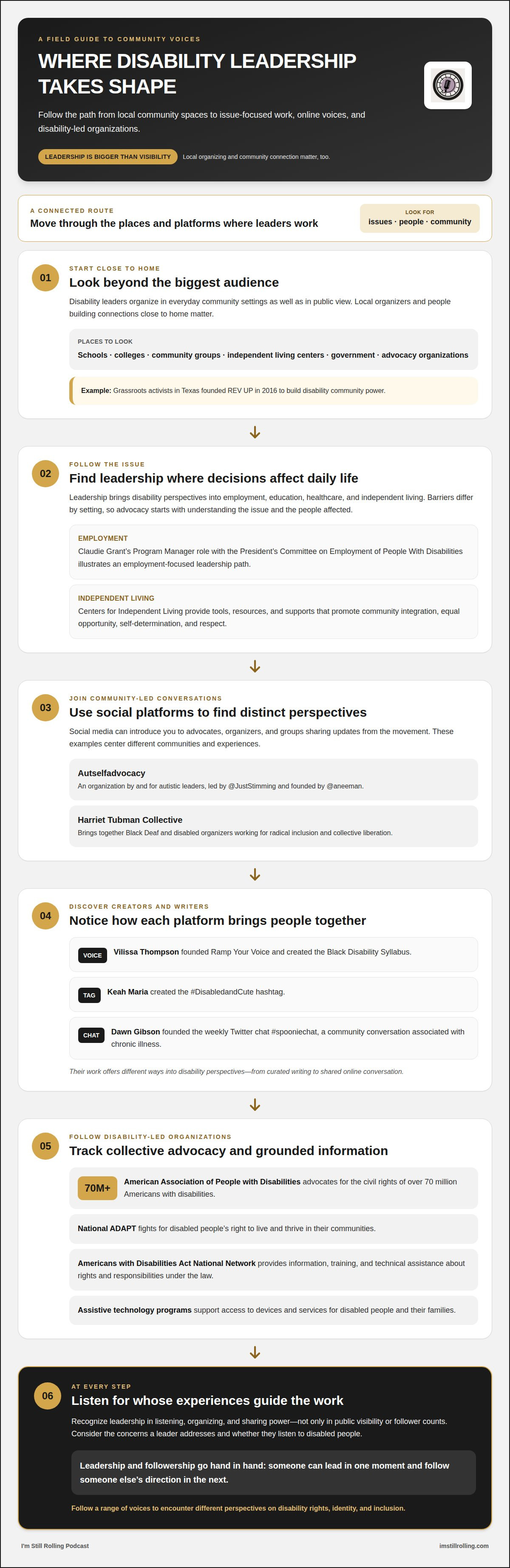
A disability leader doesn’t need a huge following to shape a community. Disability community leaders to follow may be organizing in schools, colleges, community groups, independent living centers, government, or advocacy organizations, as well as speaking to a wider audience online. Leadership also means listening: people can lead in one moment and follow someone else’s direction in the next.
It’s natural to look first for well-known advocates when you want informed voices on disability rights and community life. But influence isn’t measured by visibility alone. Local organizers and people building connections close to home matter, too.
This article explores how disability rights leaders shape their communities, why leadership and followership go hand in hand, and where to find voices worth following. You’ll also encounter advocates and organizations offering different perspectives, so you can choose whom to listen to based on the issues and communities you care about.
Table of Contents
Disability rights leadership
Disability rights leadership turns lived experience into advocacy, community organizing, and public influence. Leaders work across employment, education, healthcare, and independent living, often by listening first and acting alongside others.
Influential Disability Community Leaders
Influential disability community leaders help shape public understanding, priorities, and advocacy. Their influence can come from organizing, expertise, or creating spaces where disabled people’s experiences guide decisions, not simply from having a large audience. Sins Invalid originated the Disability Justice framework, while Crip the Vote was founded by @SFdirewolf, @AndrewPulrang, and @GreggBeratan. These examples show that leadership takes many forms.
Leadership also means knowing disability history, rights, and advocacy strategies. The Americans with Disabilities Act is identified as PL 101-336, and disability leaders should understand laws like it while advocating for disabled people’s rights. Judith Heumann’s appearance in a Drunk History episode about Section 504 connects an influential advocate with education access. A leader’s role can include explaining the history behind a movement, listening to community concerns, and helping turn shared priorities into action.
Leadership Across Key Areas
Leadership in employment, education, healthcare, and independent living brings disability perspectives into decisions that affect people’s lives. It matters because barriers differ by setting, so effective advocacy starts with understanding both the issue and the people affected. Claudie Grant’s Program Manager role with the President’s Committee on Employment of People With Disabilities illustrates an employment-focused leadership path.
Other examples connect leadership to education and community participation. The Leadership 2000 project of the Disability and Employment Concerns Standing Committee and Howard University’s Bridges To Leadership 2000 project assisted in empowering minority people with disabilities. For independent living, Centers for Independent Living provide tools, resources, and supports that promote community integration, equal opportunity, self-determination, and respect. In healthcare and other areas, identify leaders by the concerns they address and whether they listen to disabled people. Grassroots activists in Texas founded REV UP in 2016 to build disability community power, showing how organized local action can strengthen collective advocacy.
Places to find disability community leaders
Disability leaders work in community organizations, schools, colleges, independent living centers, government, and advocacy groups. Social platforms can also introduce you to advocates whose work focuses on particular experiences.
Activists and Advocates on Social Media
Social media can connect you with disability advocates, organizers, and groups sharing updates from the movement. Autselfadvocacy is an organization by and for autistic leaders, led by @JustStimming and founded by @aneeman. The Harriet Tubman Collective brings together Black Deaf and disabled organizers working for radical inclusion and collective liberation. Following these groups can introduce you to advocacy shaped by community priorities.
Disabled Creators, Writers, and Journalists
Disabled creators and writers use public platforms to share ideas, identity, and community conversation. Vilissa Thompson founded Ramp Your Voice and created the Black Disability Syllabus. Keah Maria created the #DisabledandCute hashtag, while Dawn Gibson founded the weekly Twitter chat #spooniechat. Their work offers different ways to encounter disability perspectives, from curated writing to shared online conversation.
These creators are useful starting points for discovering disabled voices across public culture and advocacy.
Leaders Focused on Disabilities and Chronic Illnesses
Some leaders center a particular disability community or shared experience. Autselfadvocacy focuses on autistic leadership, while the Harriet Tubman Collective represents Black Deaf and disabled organizing. Dawn Gibson’s #spooniechat creates a community conversation associated with chronic illness. These examples can help you find voices connected to the issues, identities, or communities you want to understand more deeply.
Disability-Led Organizations and Their Leaders
Disability-led organizations offer ways to follow collective advocacy, not only individual voices. The American Association of People with Disabilities advocates for the civil rights of over 70 million Americans with disabilities. National ADAPT fights for disabled people’s right to live and thrive in their communities. For practical information, the Americans with Disabilities Act National Network provides information, training, and technical assistance about rights and responsibilities under the law. Assistive technology programs also support access to devices and services for disabled people and their families. These organizations can help allies and families find grounded information while centering disability-led advocacy.
Who are influential disability community leaders in the United States?
Influence in disability communities takes many forms: building a platform, bringing people together, or shaping advocacy. In the United States, Vilissa Thompson, Keah Maria, and Dawn Gibson show how distinct efforts can create space for disability voices. Their work offers more than a list of names; it shows how leaders can connect people around a shared idea or conversation.
Vilissa Thompson founded Ramp Your Voice and created the Black Disability Syllabus. These projects offer a useful starting point for readers interested in disability advocacy and Black disability perspectives. When following an organizer’s work, notice what they bring forward and whose experiences their platform centers. A creator can have an impact by making an overlooked perspective harder to ignore.
Keah Maria created #DisabledandCute, a hashtag that opened a shared space for disabled people to express pride and visibility. A hashtag can help people find one another, join a conversation, and encounter perspectives beyond a single account. Explore the community around it, not just the person who began it. That broader view reveals how an individual initiative can grow into collective expression.
Dawn Gibson founded the weekly Twitter chat #spooniechat, creating a recurring gathering around chronic illness. It offers a different kind of influence from a syllabus or hashtag: a scheduled conversation where participants can exchange perspectives. Follow how the discussion develops, which topics recur, and how participants contribute. This example shows that leadership can mean making room for others to speak.
These leaders represent different ways of shaping disability culture, but no single voice can speak for every disabled person. Use their work as a starting point, then follow the issues and communities that matter to you. Ramp Your Voice, the Black Disability Syllabus, #DisabledandCute, and #spooniechat each offer a distinct lens. Comparing them can help you see how advocacy, cultural expression, and community conversation intersect.
Which disability rights activists and advocates should I follow on social media?
Choose social media voices by the communities they represent and the issues they address. Autselfadvocacy is an organization by and for autistic leaders, led by @JustStimming and founded by @aneeman. Following its leaders can introduce you to advocacy shaped by autistic people’s perspectives. Notice which concerns they raise, whose experiences appear, and how they invite community participation.
The Harriet Tubman Collective brings another distinct perspective: Black Deaf and disabled organizers working for radical inclusion and collective liberation. Its work can help you understand how disability advocacy connects with race, deafness, and collective organizing. Follow the collective’s posts to hear its priorities directly, rather than relying only on summaries from people outside the community.
For civil rights advocacy, the American Association of People with Disabilities advocates for the civil rights of over 70 million Americans with disabilities. Its social channels can offer a view of advocacy framed around broad disability community concerns. National ADAPT focuses on disabled people’s right to live and thrive in their communities. Following both organizations makes it possible to compare how different groups communicate priorities and describe change.
Build a thoughtful feed by following disabled-led voices, reading beyond headlines, and noticing which communities each account centers. For example, Autselfadvocacy offers an autistic-led perspective, while the Harriet Tubman Collective centers Black Deaf and disabled organizers. AAPD and National ADAPT add organizational advocacy. Together, these accounts can broaden your feed without suggesting that one person or group speaks for everyone.
Social media is a starting point, not a complete picture of an organization’s work. Read posts in context, follow links to longer statements, and listen when advocates explain what their communities need. To explore more disability-focused stories and conversations, discover disability perspectives.
The Americans with Disabilities Act National Network funds 10 regional centers for information, training, and technical assistance on rights and responsibilities under the Americans with Disabilities Act.
I'm Still Rolling Podcast: I'm Still Rolling Podcast Episodes
I'm Still Rolling Podcast offers conversations that bring lived experience into the search for disability voices and perspectives. Hosted by Mike Sugarman and Janice Wright, its episodes feature guests who have faced challenging circumstances and discuss disability, resilience, and life after adversity.
Turn to the episodes when you want personal stories alongside thoughtful discussion of disability rights, caregiving, and growth. Podcast transcripts provide a text format for following the conversations, while the I'm Still Rolling Newsletter offers another way to stay connected with the show’s stories.
For a deeper understanding of disability leadership, listening to people describe their own experiences can complement following advocates and organizations. Visit imstillrolling.com to explore the conversations, newsletter, and transcripts.
Let listening become a way to participate
Following disability community leaders means more than collecting names or accounts. Let what you hear shape how you listen, whose perspectives you seek, and how you make room for disabled people’s voices in everyday conversations. Disability community leaders to follow are not a single, unified group; each brings a distinct experience and focus. Stay curious and let those differences deepen your understanding, rather than searching for one voice to speak for everyone.
Choose a perspective that stays with you, then keep listening beyond a single post or conversation. Share thoughtful work with care, and be open to following when others are leading. That kind of attention can turn interest into more respectful connection.
If personal stories and candid conversations help you keep listening, connect with I'm Still Rolling Podcast. Let each new voice widen the conversation and make room for what comes next.
Frequently Asked Questions
Who are leading advocates for disability rights, accessibility, and inclusion?
Start with advocates and organizations whose work matches the issue you want to understand. The people and groups discussed above offer different entry points, from disability rights and civil rights advocacy to community inclusion and disability pride. To decide whom to follow, consider which communities each voice centers and what work they discuss. A thoughtful mix of disability community leaders to follow can bring varied perspectives into view.
How can I find disability community leaders and advocates in my state or city?
Look for disabled-led groups and advocates active in local community life. Search your city or state alongside terms such as disability advocacy, independent living, or disability pride, then see which groups host public meetings or community activities. Schools, colleges, and local advocacy organizations can also connect you with voices close to home. Attending a public meeting can help you hear which issues local advocates are addressing.
Comments