Discussing Disability at Work: Choosing What to Share
You don’t have to make your diagnosis the focus of a workplace conversation. In the United States, you generally don’t have to disclose a disability during an interview unless you need an accommodation for the hiring process. At work, you may need to share enough information to request an accommodation. Knowing how to discuss your disability at work can mean explaining how it affects your tasks and what support would help, rather than sharing your full medical history.
It’s understandable to weigh your privacy against an employer’s need to know what would help you do your job. There’s no single right moment or script. This article explains why and when you might disclose, what information can help with an accommodation request, and how to approach the subject in an interview. It also covers how to keep the conversation focused on the role while deciding what feels right to share.
Table of Contents
Disclosing Multiple Disabilities for Accommodations
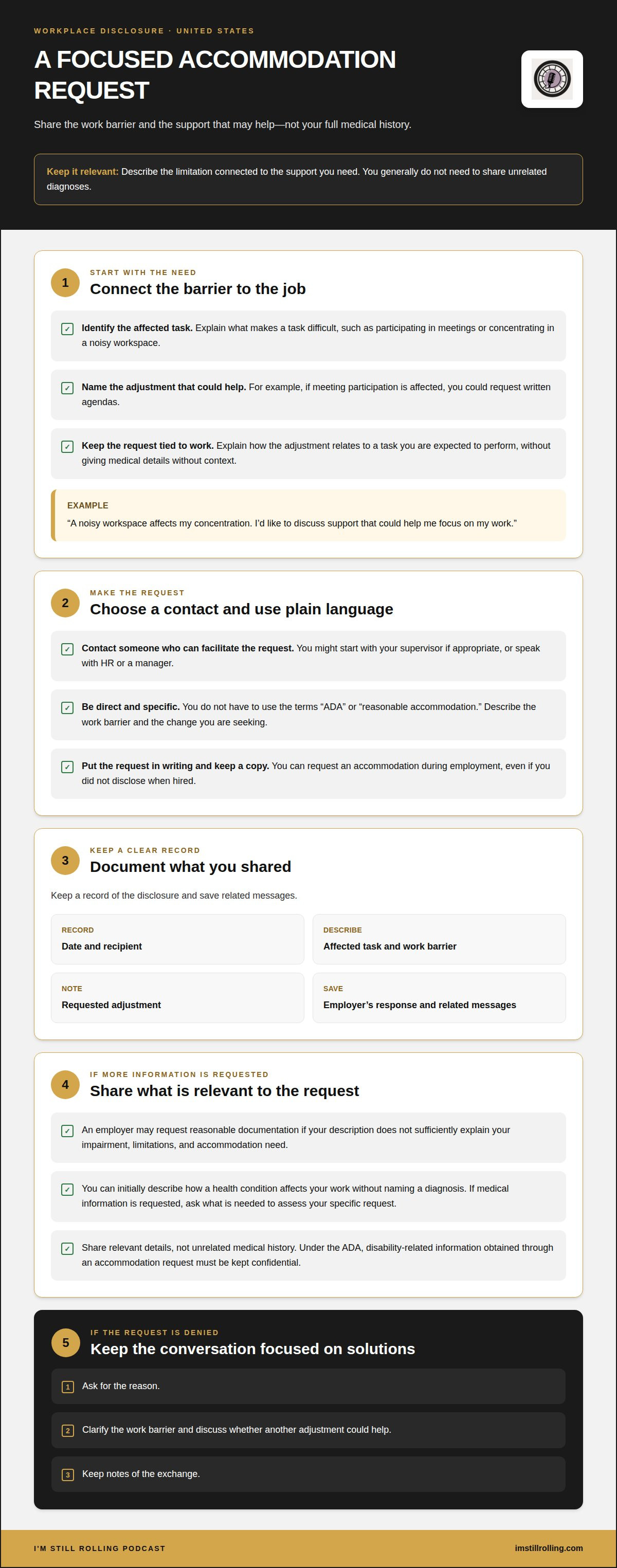
In the United States, you can focus an accommodation request on the disability-related need for support. Describe the barrier at work and the adjustment that could help.
Disclosing Only the Relevant Disability
If you have multiple disabilities, focus on the one relevant to the accommodation you’re requesting. You generally don’t need to describe unrelated diagnoses to explain a specific workplace need. For example, if a condition affects your concentration in a noisy workspace, explain that impact and the support you’re seeking. This keeps your request focused while giving the appropriate person information to consider it.
Connecting Accommodations to Key Job Tasks
Connect the accommodation to a task you’re expected to perform, rather than sharing medical details without context. Explain what makes the task difficult and what change may help. For example, you could describe how a limitation affects your participation in meetings and request written agendas. Specific examples show how an accommodation relates to your work without implying that you can’t perform the role’s essential duties.
Making an Accommodation Request
You can request an accommodation during employment, even if you didn’t disclose your disability when hired. Start with your supervisor if that feels appropriate, or speak with HR or a manager who can facilitate the request. Use plain language; you don’t have to say “ADA” or “reasonable accommodation.” Put the request in writing and keep a copy. If your employer denies it, ask for the reason, clarify the work barrier, and discuss whether another adjustment could help. Keep notes of that exchange.
Medical Information and Request Documentation
An employer may request reasonable documentation if your description doesn’t sufficiently explain your impairment, limitations, and accommodation need. You can initially describe how a health condition affects your work without naming a diagnosis. Keep a record of your disclosure, including the date, recipient, affected task, requested adjustment, and response. Save related messages. If the employer requests medical information, ask what’s needed to assess your specific request and share relevant details, not unrelated history. Under the ADA, disability-related information obtained through an accommodation request must be kept confidential.
Reasons to disclose a disability at work
Disclosure is a personal choice that can change with the situation and the support you need. In the United States, you generally don’t have to disclose unless you’re requesting a work-related accommodation. The ADA provides a basis for that request, and the Rehabilitation Act also protects qualified applicants and employees in relevant settings. Sharing a disability-related need can help an employer arrange support and fairly assess your ability to perform essential tasks.
The rules for job applicants differ from those for current employees. Before a conditional job offer, the ADA generally prohibits employers from asking disability-related questions or requiring medical exams. The U.S. Equal Employment Opportunity Commission says employers may not ask questions likely to reveal a disability before making an offer. Applicants generally don’t need to disclose unless they need an accommodation for the application or interview, such as an accessible format or an adjustment for a work sample.
After a conditional job offer, employers may ask disability-related questions or require medical exams if they do so for all entering employees in the same job category. They may also ask about an applicant’s full medical history if they ask the same questions of other applicants offered that type of job. An employer can’t withdraw the offer based on this information unless the applicant can’t perform essential job functions with or without accommodation, or poses a direct threat to themselves or others.
Some applicants wait until they receive an offer; others disclose earlier to arrange an interview adjustment or explain how they’ll perform the role’s key tasks. There’s no single right moment. Consider your privacy, the job requirements, and whether an accommodation would help you take part or work effectively.
During employment, consider disclosing when an accommodation need becomes clear, before your performance suffers or conduct concerns arise. An employer may not know you need support until you explain the workplace barrier. Disclosing only after a performance review or disciplinary action doesn’t require an employer to reverse an otherwise warranted evaluation or decision. A timely conversation gives both sides a chance to address the need before it affects your work.
Am I lying if I do not share information about my disability?
No. In the United States, you’re generally not legally required to disclose a disability to an employer or during a job interview. Choosing not to discuss a diagnosis isn’t the same as lying. If you request an accommodation, explain the work-related limitation and the support you need. You can keep the details focused on the role, your skills, and the adjustment that would help you do the job.
The Americans with Disabilities Act (ADA) requires employers to keep disability-related information confidential when they receive it through a required medical exam, medical question, or accommodation request. This protection applies to information obtained through those channels, not every conversation about health. For example, if you casually tell a supervisor about a diagnosis, clarify what you’re sharing and what you need them to know.
When confidentiality requirements apply, employers must store disability-related medical information separately from personnel records. A manager may need information to arrange an appropriate accommodation, but that doesn’t mean every colleague needs your diagnosis. You can ask who will receive the information and how it will be used. Keep your own copy of written requests and relevant replies, as in the earlier documentation steps.
Respectful treatment matters, too. The ADA prohibits hiring decisions based on disability, and generally restricts disability-related questions before a job offer. After you start work, questions about disability-related needs should focus on workplace support. Questions should focus on whether you need an accommodation and what kind, not on curiosity about your medical history.
Can an employer retaliate against or discriminate against you for disclosing a disability? The ADA protects qualified applicants and employees from disability-related discrimination, and employers can’t make hiring decisions based on disability. If you believe disclosure led to unfair treatment, record the dates, statements, and decisions involved, then raise your concern through an appropriate workplace channel. Focus on specific conduct, such as a changed assignment or a decision that appears connected to your disclosure.
Discussing a disability during an interview
An interview is a chance to show how your skills match the position, not a requirement to share a diagnosis. In the United States, the ADA generally doesn’t require applicants to disclose unless they need a reasonable accommodation for the hiring process. The U.S. Equal Employment Opportunity Commission says employers may not ask questions likely to reveal a disability before making a job offer. They may ask whether you can perform essential job functions, with or without accommodation.
If you’re considering how to discuss your disability at work during an interview, start with the support you need to participate. For example: “I have a condition that affects my ability to read printed materials. Could you provide the assessment in an accessible digital format?” If you request an interview accommodation, focus on explaining the support you need and share only information relevant to the request. Keep your explanation tied to the interview task rather than sharing your medical history.
There’s no single right moment to disclose. If you don’t need an interview accommodation, you may choose to wait until you’ve established rapport and demonstrated your abilities. If a disability is visible during a video or in-person interview, prepare a concise response that brings the focus back to the work: “I use a mobility aid, and I can perform the role’s listed tasks.” The ADA prohibits hiring decisions based on disability, so rejecting someone for that reason is illegal.
Practicing how to discuss your disability at work can make the conversation feel less improvised. Rehearse with someone you trust, then write a brief script: mention relevant information, name any accommodation, and return to your qualifications. For a work sample, request an adjustment before completing it. If you’re offered the position, discuss any workplace accommodation with the appropriate supervisor before your start date so it can be arranged. To hear lived experiences that may help you prepare, listen to candid disability stories.
I'm Still Rolling Podcast: I'm Still Rolling Podcast Episodes
I'm Still Rolling Podcast features honest conversations about disability, resilience, and life after adversity. After considering what to share at work, hearing people describe their experiences can offer another perspective on the emotions and decisions that may come with disclosure. These stories don’t replace workplace guidance, but they can create space for reflection beyond the practical steps.
Choose an episode when you want to hear people share their experiences in their own words. The I'm Still Rolling Newsletter offers another way to stay connected, while Podcast Transcripts let you read episode conversations at your own pace.
Visit imstillrolling.com to explore episodes, the newsletter, and transcripts.
Take Your Next Step at Your Own Pace
Deciding how to discuss your disability at work doesn’t mean you have to prepare for every possible question at once. Choose the conversation that feels most immediate, then write down what you want the other person to understand. You might note a boundary you want to maintain, a work concern you want addressed, or the first sentence you’d feel comfortable saying. A small, clear starting point can make the next decision feel less overwhelming.
You’re allowed to approach the conversation in a way that reflects your priorities and your own sense of timing. If you’d like to continue exploring disability and resilience through honest stories, contact I'm Still Rolling Podcast. Your experience is yours to share, and you can take the next step on your terms.
Frequently Asked Questions
Why Disclose in the Workplace?
Disclosure can help an employer understand a workplace need that otherwise may remain invisible. For example, if frequent medical appointments affect your schedule, explaining that barrier can open a conversation about a flexible schedule. You might also choose to share information when a task becomes difficult, so your supervisor can assess your work in context. The decision remains personal, shaped by your needs and comfort.
Can an interviewer ask questions about my disability or have me get a medical exam?
Before a conditional job offer, employers generally can’t ask disability-related questions or require medical exams. The U.S. Equal Employment Opportunity Commission says they may not ask questions likely to reveal an applicant’s disability before making an offer. An interviewer can ask whether you can perform essential job functions, with or without accommodation. After a conditional offer, questions or exams must apply to all entering employees in the same job category.
Can my employer tell others that I have a disability?
Under the ADA, disability-related information obtained through a required medical exam, medical question, or accommodation request must be kept confidential. When confidentiality requirements apply, employers must store medical information separately from personnel files. A colleague who doesn’t handle your accommodation usually doesn’t need to know your diagnosis. You can ask your supervisor who needs information to arrange support and what work-related details they’ll receive.
Do I need to say that I have a disability when I apply for a job?
No, you generally don’t need to disclose a disability on an application or résumé. If you need an adjustment to complete an application or interview, you can request support without giving a diagnosis. Employers may ask voluntary disability questions for affirmative action purposes, but applicants don’t have to answer. For example, you can leave an optional question blank and separately request an accessible application format.
What Does “Disclosure” Mean?
Disclosure means sharing disability-related information with an employer or another appropriate workplace contact. It can be as limited as explaining that a health condition affects a particular task, or as specific as naming a diagnosis. You don’t have to give everyone the same information. For example, you might tell a supervisor about a limitation while keeping personal medical details private from coworkers.
What if I need to ask for an accommodation to do the job?
Tell an appropriate workplace contact which task is affected and what adjustment could help. You can make the request in plain English, without legal terms. For example, explain that your desk setup makes it difficult to reach work materials and describe the change that would help. Keep a written record of your request. If your explanation doesn’t clarify the limitation and support you need, your employer may request reasonable documentation.



Comments