Spinal Cord Injury Recovery Stories: Resilience Beyond the Medical Chart
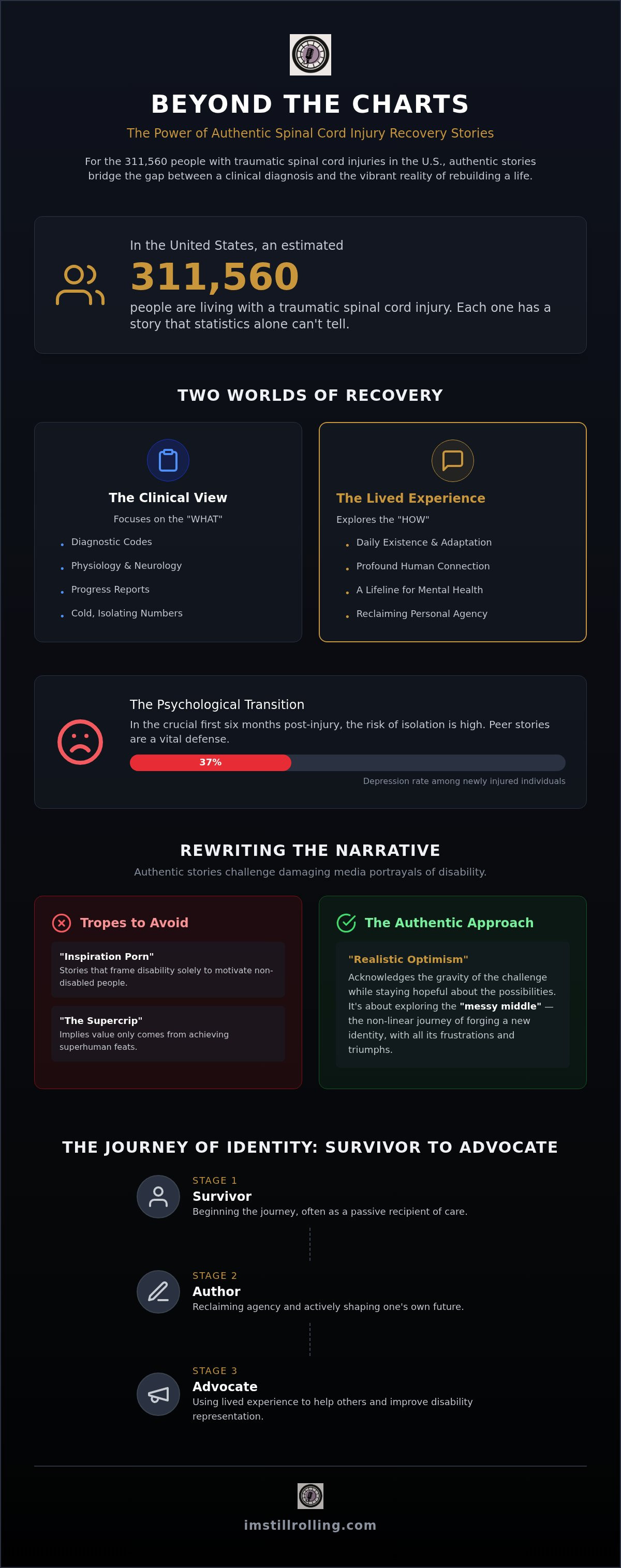
What if the most vital chapters of your life aren't found in a hospital discharge summary or a physical therapist's progress report? For the 311,560 people living with traumatic spinal cord injuries in the United States, clinical data often fails to capture the messy, beautiful reality of rebuilding a life. You might feel like you've been reduced to a series of diagnostic codes, fearing that your old identity has been permanently replaced by a medical folder. It's exhausting to be viewed through the lens of what you've lost rather than who you're becoming. This is why authentic spinal cord injury recovery stories matter; they serve as a necessary bridge between the sterile environment of a clinic and the vibrant, complex world waiting for you outside.
We're moving beyond the clinical filter to explore the raw, journalistic truth of life after injury. In the following sections, you'll discover a community of peers who have navigated the same isolation and emerged with a renewed sense of self. We'll provide a clear overview of the emotional roadmap that follows a diagnosis, highlighting examples of professional and personal success that prove life doesn't end at the hospital doors. This is a deep dive into the endurance required to thrive, focusing on the discovery of meaning within the struggle.
Table of Contents
The Power of Spinal Cord Injury Recovery Stories: Beyond the Charts
A medical chart is a map of a territory, but it's never the journey itself. While understanding spinal cord injury requires a grasp of neurology and physiology, these clinical markers often fail to account for the human spirit's capacity to recalibrate. True spinal cord injury recovery stories aren't just about the millimeters of movement regained in a thumb or the gradual return of sensation; they are narratives of profound human adaptation. They chronicle the quiet, internal revolution that occurs when a person decides that their life is still worth living, even when the physical parameters have shifted. By focusing on the person rather than the patient, we begin to see recovery as a holistic reconstruction of a life well-lived.
Why Real Narratives Outperform Clinical Data
Clinical data provides the "what" of a diagnosis, but storytelling provides the "how" of daily existence. Statistics tell us that approximately 311,560 people in the United States live with traumatic spinal cord injuries, yet those numbers can feel cold and isolating to someone sitting in a rehab gym. For those in the first six months of injury, peer stories are a vital lifeline for mental health. Some medical journals report that depression rates can reach 37 percent among those newly injured, a figure that highlights the weight of isolation. Hearing from others who have navigated the same darkness allows survivors to reclaim their agency, transforming them from passive recipients of care into active authors of their own futures.
Identifying with the 'Messy Middle' of Recovery
The media often favors "miracle" tropes, focusing exclusively on the rare cases of complete neurological recovery. This creates a damaging binary where you're either "cured" or "broken," leaving no room for the reality of living a full, vibrant life with a disability. We need stories that explore the messy middle. This includes the bad days, the logistical frustrations of a C-level injury, and the specific triumphs of T-level independence. Recovery is a non-linear journey of identity reconstruction where the goal isn't to return to a previous version of yourself, but to forge a new one. At the I'm Still Rolling Podcast, we lean into this "realistic optimism," a term that acknowledges the gravity of the challenge while remaining fundamentally hopeful about the possibilities of a life in motion.
Redefining Resilience: A Journalistic Look at Life After SCI
Most media coverage of disability falls into two distinct, often unhelpful camps: the clinical tragedy or the miraculous triumph. Neither of these extremes feels particularly real to a person navigating the daily logistics of paralysis. Professional journalism offers a third way, providing a lens that uncovers the nuance often lost in hospital brochures or legal briefs. By examining spinal cord injury recovery stories through a reporter's lens, we can strip away the gloss and the pity to find the authentic truth of human endurance. This approach doesn't just look for a happy ending; it looks for the reality of how people rebuild their lives, piece by piece, with a grounded sense of purpose.
Moving Beyond Disability Tropes
In the disability community, the term "inspiration porn" describes stories that use a person's disability as a motivational tool for non-disabled people. Closely related is the "supercrip" trope, which suggests that a person with a spinal cord injury is only valuable if they are winning marathons or achieving superhuman feats. These narratives are harmful because they set an impossible standard and ignore the systemic hurdles of living with a disability. We favor unflinching honesty instead. This means looking at the process of finding purpose after disability as a complex, ongoing project rather than a single, heroic moment. Mike Sugerman and Janice Wright apply their decades of investigative rigor to these personal hardships, ensuring that every story told is as accurate as it is intimate.
The Role of Vulnerability in Storytelling
There is a unique trust that forms when a story is told by a "vulnerable peer" rather than a clinical expert. While doctors understand the mechanics of the spine, they don't necessarily understand the emotional weight of the first night home from the hospital or the anxiety of a first date post-injury. Journalistic reporting techniques, such as long-form interviewing and active listening, help guests share these deeper truths. These conversations often reveal that resilience isn't about beating the odds in a medical sense, but about the steady, quiet work of adaptation. The result is a steady pulse of connection that reminds listeners they aren't alone in their struggle. If you're looking for a community that values this type of raw, honest dialogue, exploring recent I'm Still Rolling Podcast Episodes can provide the perspective you need to move forward with realistic optimism.
Navigating the New Normal: Real-Life Stories of Adaptation
The hospital discharge marks the end of a medical phase, but it's the beginning of a complex social and logistical recalibration. We often hear about the big breakthroughs, but the true substance of spinal cord injury recovery stories is found in the quiet "firsts" that happen after the rehab center doors close. These are the moments where theory meets the pavement. It's the first solo trip to the grocery store, where reaching for a top-shelf item becomes a lesson in creative problem-solving. It's the first flight, where navigating narrow aisles and airline logistics tests both patience and planning. These experiences are the building blocks of a new life, proving that while the physical parameters have changed, the capacity for adventure and daily routine remains intact.
Adaptation also requires a fundamental shift in how we view our professional selves. For many, a traumatic injury necessitates a career pivot. When a previous role is no longer accessible, survivors often discover new professional passions in fields like technology, writing, or advocacy. These aren't just backup plans; they are evolutions. Technology plays a massive role here, with voice-to-text software and smart home modifications acting as silent partners in the recovery narrative. By integrating these tools, survivors move from a state of being cared for to a state of total agency, reclaiming their roles as providers, parents, and leaders.
Logistics of the Modern World in a Chair
Urban environments often feel like obstacle courses designed for a different species. Navigating wheelchair life challenges in a city involves a constant negotiation with broken elevators, steep curb cuts, and narrow doorways. Beyond the physical barriers, there is the "public gaze" to manage. People often look at the chair before they look at the person, leading to social interactions that can feel filtered through pity or awkwardness. Authentic spinal cord injury recovery stories don't shy away from these frustrations. Instead, they highlight the importance of adaptive equipment that feels like a personal tool rather than a medical device, allowing the user to move through the world with dignity and style.
Reclaiming Autonomy and Independence
Driving again is perhaps the most significant milestone in reclaiming independence. The installation of hand controls offers more than just transportation; it offers the return of spontaneous choice. This transition from being a passenger to a driver mirrors the internal transition from being a "patient" to being a partner or a parent in domestic life. The moment of "clicking" back into a social role occurs when the chair becomes secondary to the conversation, and you find yourself fully immersed in the rhythm of a dinner party or a business meeting without the weight of your diagnosis looming over the table. It's a return to the self, recalibrated for a different way of moving.
Healing the Spirit: The Psychological Transition of Disability
While physical therapy focuses on the body, the most grueling work often happens within the psyche. Identity grief is a profound reality for those featured in spinal cord injury recovery stories; it's the mourning of a former self that occurs while the world expects you to focus solely on physical gains. This transition isn't a side effect of the injury but a central part of the experience. Emotional recovery frequently takes years longer than the initial rehabilitation period because it requires a complete reimagining of your place in the world. It involves reconciling the person you were with the person you're becoming, a process that is both exhausting and deeply transformative.
Navigating the Emotional Shift
Moving through the stages of psychological adaptation often involves shifting from the stagnant question of "Why me?" to the active pursuit of "What now?" This is where realistic optimism becomes a functional tool. It's about acknowledging the weight of the hardship without letting it anchor you in place. This mindset prevents the burnout that often plagues both survivors and their caregivers. Open communication with loved ones is essential during this phase. You must learn to articulate changing physical and emotional needs as you move away from the "patient" role and back into the role of a peer, partner, or parent.
Finding Community and Shared Experience
Finding your tribe is the most effective antidote to the sterile isolation of medical environments. There's a specific, healing power in the shared laugh that comes from finding humor in the absurdities of disability. Whether it's a joke about a malfunctioning wheelchair or the awkwardness of public encounters, these moments of levity signal that you've moved from survival into life. Digital spaces and podcasts now act as virtual support groups, providing a steady pulse of connection for the newly injured who may not have access to local peers. These platforms offer a safe space for deep reflection and the discovery of meaning within the struggle.
The I'm Still Rolling podcast serves as a primary source for these honest dialogues, exploring the deep emotional impact of disability without the clinical filter. If you're ready to hear from those who have walked this path and found their way back to a sense of self, you can listen to our latest podcast episodes to find your own community and start your journey toward emotional resilience.
Finding Your Voice: Advocacy Through Authentic Storytelling
The transition from survivor to advocate is a profound shift in perspective. It begins when you realize that your lived experience isn't just a private burden, but a public asset. By documenting your journey, you contribute to a growing body of spinal cord injury recovery stories that challenge the status quo and demand a more inclusive world. Your voice becomes a powerful tool for change, influencing accessibility laws and societal attitudes by providing a human face to abstract policy issues. This is the ultimate act of reclaiming your identity; you are no longer a medical case study, but a leader in a movement that values the expertise of those with lived experience.
The Impact of Disability Journalism
We need more journalistic podcasts about disability to dismantle the persistent stereotypes that flatten the SCI experience. Professional reporting helps to move beyond the binary of tragedy and triumph, uncovering the systemic barriers that often hinder true recovery. Media partnerships can amplify these voices, ensuring that the community isn't just spoken about, but is doing the speaking. Our mission at I'm Still Rolling is to move the needle on empathy and inclusion through rigorous, honest storytelling. By providing a platform for these narratives, we foster a world where disability is understood as a natural part of the human condition rather than a problem to be solved.
How to Share Your Story
Starting your own journey of documentation doesn't require a professional studio or a massive platform. You can begin with a simple blog, a dedicated social media channel, or even a guest segment on an established podcast. The most important element is your authentic perspective. Overcoming the fear of vulnerability is often the first hurdle, yet it's your most honest truths that will resonate most deeply with others. Whether you're discussing the logistics of travel or the nuances of identity grief, your story has the power to educate the non-disabled world and support your peers.
If you aren't sure where to start, looking at how others have found their voice can provide a helpful roadmap. To find examples of people who have turned their personal hardships into a source of public strength, listen to the latest recovery stories on the I'm Still Rolling Podcast. Seeing the impact of these spinal cord injury recovery stories can provide the spark you need to begin documenting your own path of resilience and advocacy.
Embracing the Unwritten Chapters of Your Journey
The path forward after a life-altering injury is rarely found in a clinical manual. It's built through the steady, daily work of adaptation and the courageous act of reclaiming your voice. We've explored how spinal cord injury recovery stories serve as more than just inspiration; they are blueprints for a new way of existing in a world that often overlooks the nuances of disability. By moving beyond medical tropes and embracing the psychological transition of identity grief, you transform your narrative from one of loss to one of profound, realistic optimism. Your lived experience is the most powerful tool you possess for both personal healing and broader advocacy.
If you're looking for a community that values truth over platitudes, we invite you to join our global network of listeners and survivors. Hosted by award-winning journalists, our podcast provides a safe space for the honest, unfiltered conversations that the medical world often misses. Subscribe to I'm Still Rolling for more stories of resilience and discover the strength that comes from shared experience. You don't have to navigate this roadmap alone; there is a whole community waiting to roll alongside you.
Frequently Asked Questions
Can a person fully recover from a spinal cord injury?
Complete neurological recovery is rare, with less than 1 percent of individuals achieving it by the time they are discharged from the hospital. Instead, the focus of spinal cord injury recovery stories shifts toward functional independence and identity reconstruction. While physical gains are vital, most survivors find that "recovery" ultimately means adapting to a new way of moving through the world with resilience and purpose.
What are the most common causes of spinal cord injuries in 2026?
Vehicle crashes remain the leading cause of traumatic spinal cord injuries in 2026, accounting for 37.3 percent of new cases. This is followed closely by falls at 32.0 percent, which have been steadily increasing as a cause since the 1970s. Violence and sports related incidents round out the primary causes at 15.5 percent and 7.7 percent, respectively, reflecting the diverse circumstances that lead to life altering injuries.
How long does the emotional recovery from an SCI typically take?
Emotional recovery is a non-linear process that frequently takes years, often extending far beyond the initial 36.3 days of average rehabilitation. It involves navigating identity grief and reconciling your former self with your current reality. Because this transition is deeply personal, there is no fixed timeline. Many survivors find that the psychological adaptation continues as they encounter new milestones in their professional and social lives.
Is it possible to live an independent life with quadriplegia?
Living an independent life with quadriplegia is entirely possible through a combination of adaptive technology, home modifications, and personal agency. Modern tools like voice to text software, smart home systems, and specialized hand controls for driving allow individuals with high level injuries to reclaim their autonomy. Independence isn't defined by physical ability alone, but by the capacity to make choices and lead a self directed life.
Where can I find a community of other SCI survivors?
You can find a vibrant community of survivors through digital platforms, local peer support groups, and immersive media like the I'm Still Rolling podcast. These spaces offer a safe environment for honest reflection and shared laughter, which are essential for breaking the isolation of medical trauma. Connecting with peers who understand the logistical and emotional nuances of disability provides a steady pulse of support during the recovery journey.
How do recovery stories help with the rehabilitation process?
Authentic spinal cord injury recovery stories assist the rehabilitation process by providing a practical roadmap that clinical data cannot offer. Hearing how others navigated their first social outings or returned to work helps reduce the 37 percent depression rate often seen in newly injured individuals. These narratives offer realistic optimism, showing that a full life is achievable even when the physical parameters have permanently shifted.
What is the difference between an 'inspirational' story and a 'journalistic' story?
Inspirational stories often rely on "inspiration porn" tropes that simplify the disability experience into a single heroic moment. In contrast, journalistic stories utilize professional rigor to explore the "messy middle" of adaptation with unflinching honesty. A journalistic approach prioritizes the authentic truth of human endurance, acknowledging the gravity of the struggle without descending into pity or superficial cheerfulness.
Can I share my own story on the I'm Still Rolling podcast?
The I'm Still Rolling podcast is always looking for honest, raw perspectives that challenge standard disability tropes. We focus on conversations that blend personal history with broader insights into the human condition and internal resilience. If you have a journey you'd like to document, engaging with our global community of listeners is a great first step toward transforming your experience from a private struggle into a powerful tool for advocacy.


Comments