Stories of Recovery and Hope: Finding Light After Life-Altering Adversity
What if the most profound part of your story isn't the tragedy itself, but the unexpected, messy life you build in its wake? When you're standing in the wreckage of medical trauma or a devastating loss, the world often feels cold, clinical, and impossibly lonely. You aren't looking for a sterile medical brochure; you're looking for stories of recovery and hope that actually feel real. It's easy to feel like you're the only one struggling to find the surface when your "new normal" feels anything but normal.
We know that recovery is rarely a straight line. It's a non-linear excavation of a future you never planned for, a process that demands more than just the passage of time. This article provides a journalistic roadmap for finding light in 2026, drawing on the raw experiences of those who've navigated the darkest valleys. You'll discover practical strategies for emotional endurance and find a community that validates your specific, complicated journey. From the impact of the Great American Recovery Initiative to the intimate lessons of personal resilience, we're exploring how to move forward when the path ahead is still being paved.
Table of Contents
What Defines Stories of Recovery and Hope in 2026?
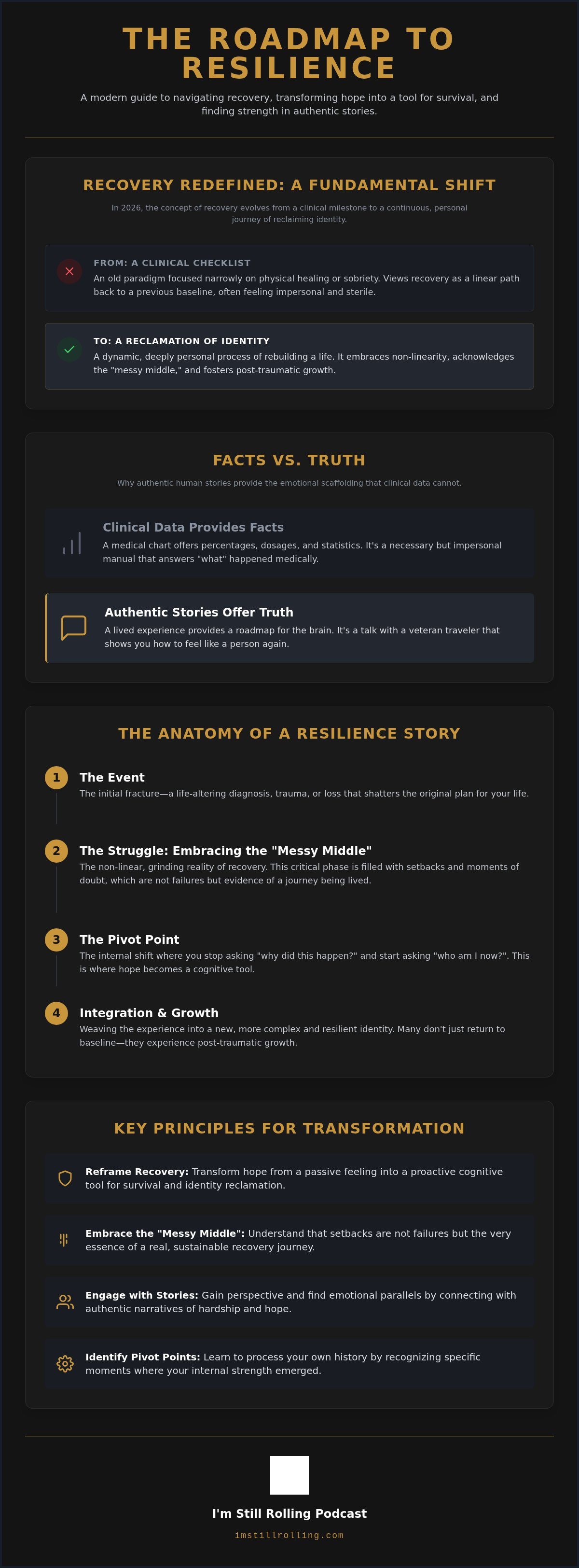
In 2026, the definition of recovery has finally expanded beyond the clinical confines of sobriety or physical healing. It's now understood as a dynamic, deeply personal process of reclaiming one's identity after it's been fractured by life-altering events. While federal programs like the Great American Recovery Initiative aim to build systemic support across housing and healthcare, the internal work happens through stories of recovery and hope. These aren't just feel-good anecdotes. They're essential blueprints for survival that provide the emotional scaffolding necessary to rebuild a life from the ground up.
We have to distinguish this grounded approach from "toxic positivity," which demands a smile while you're still bleeding. Authentic resilience is built on realistic optimism. It acknowledges the gravity of a spinal cord injury or the weight of Alzheimer's caregiving without descending into pity. Hope, in this context, is a cognitive tool rather than a passive emotion. It's an active decision to seek out meaning when the original plan for your life has been set on fire. This mindset is essential for neurological and emotional healing, as it shifts the brain's focus from perceived threats to potential pathways.
The Shift from Survival to Thriving
The days immediately following a medical trauma or a profound loss are characterized by a frantic, narrow focus on staying alive. This is survival mode. It's necessary, but it's also exhausting and isolating. The real work begins at the transition point, where you stop asking "why did this happen?" and start asking "who am I now?" This shift often leads to post-traumatic growth. Research shows that many individuals don't just return to their previous baseline; they develop a more profound appreciation for life and increased personal strength. They don't just survive the adversity; they integrate it into a more complex, resilient version of themselves.
Why Authentic Narratives Outperform Clinical Data
A medical chart can tell you the percentage of nerve function you've retained or the specific dosage of a medication, but it can't tell you how to feel like a person again. This is where authentic narratives take over. Our brains are wired for connection through mirror neurons, which allow us to experience a shadow of someone else's journey. When you hear stories of recovery and hope from someone who has "been there," your brain recognizes a roadmap. It's the difference between reading a manual and talking to a veteran traveler.
Clinical data offers facts, but stories offer truth. A trusted guide can bridge the gap between professional observation and lived intimacy, helping you navigate the "messy middle" of recovery where setbacks are frequent. By centering the human experience, we move from being passive patients to active authors of our own futures. This narrative approach transforms the clinical nature of recovery into a shared human experience that feels both authoritative and deeply personal.
The Anatomy of a Resilience Story: What Makes Hope Stick?
Every resilience story follows a predictable, yet deeply personal, skeletal structure. It begins with the event, moves into the struggle, finds a pivot point, and eventually reaches a stage of integration. However, many narratives fail because they rush toward the finish line, skipping the grinding reality of the "messy middle." Believable stories of recovery and hope are those that dwell in the setbacks. They don't hide the days when progress felt invisible or the moments when the burden seemed too heavy to carry. These setbacks aren't failures; they're the evidence of a journey that's actually being lived.
Extracting these truths requires more than just empathy. It requires a specific kind of professional distance. This is why the journalistic perspective is so vital. It allows for an excavation of the experience that moves beyond simple platitudes. If you're searching for this level of depth, the I'm Still Rolling Podcast Episodes serve as a primary resource for these long-form, non-clinical narratives.
Journalistic Rigor Meets Personal Intimacy
Mike Sugerman and Janice Wright don't just host a show; they report from the front lines of human endurance. Using techniques honed over years of award-winning journalism, they uncover the hidden truths that people often struggle to articulate. This isn't about "getting the story" in a voyeuristic sense. It's about unflinching honesty. By maintaining professional rigor while acting as fellow travelers, they create a space where disability and loss can be discussed without the filters of pity or superficial cheerfulness. A well-told story requires this balance of heart and distance to remain credible.
The Role of Vulnerability in Building Hope
Sharing the "ugly" parts of recovery isn't an act of oversharing; it's a strategic building block for community. When a speaker acts as a vulnerable peer, they break down the isolation that so often accompanies life-altering adversity. This openness creates a stronger bond with the audience, who see their own "messy" processes reflected back at them. As explored by the UC Berkeley Greater Good Science Center in their research on Finding Joy After Adversity, finding meaning requires us to acknowledge the pain before we can move through it. Resilience is the capacity to remain open despite pain.
Beyond Addiction: Recovery Stories Across the Spectrum
Recovery is often pigeonholed into addiction centers, but it's actually a universal human experience. While substance use recovery remains vital, especially with the 2026 funding levels like the $2 billion block grants mentioned in federal recommendations, it shares a profound emotional core with other forms of life-altering adversity. Whether someone is reclaiming their life from a substance or a shattered spine, the internal architecture of the journey is remarkably similar. Both require a total reconstruction of the self. This is why stories of recovery and hope are so universal; they speak to the human spirit's refusal to be defined by its limitations.
Life After Spinal Cord Injury (SCI)
The medical chart tracks vertebrae and nerve endings, but it misses the soul's transition. Moving from the intensive care unit to the living room is often the hardest part of the journey. Many survivors find that physical rehabilitation is only the first chapter. The real work lies in emotional reintegration. The "Beyond the Chair" philosophy emphasizes that purpose isn't found in a return to a previous state, but in the discovery of a new way of being. In 2026, we see spinal cord injury recovery stories that focus on vocational success, creative output, and deep interpersonal connection rather than just medical milestones.
The Caregiver's Journey: A Different Kind of Recovery
Resilience isn't always loud or visible. For those caregiving for a spouse with Alzheimer's, recovery is a quiet, daily practice. It's the process of recovering one's own identity while watching a partner's identity slowly fade. This requires a unique form of endurance. It's about finding a way to remain a whole person while serving as a primary support system. Reclaiming selfhood in the midst of cognitive decline is a heroic act of survival. These stories of recovery and hope remind us that even when the path is long and the outcome is certain, there is light to be found in the shared moments of clarity and the strength of the human bond.
How to Process and Share Your Own Story of Hope
Reclaiming your narrative after a life-altering event is a revolutionary act of self-preservation. It's a process of translation. You take the chaotic, sensory fragments of a medical emergency or a long-term diagnosis and weave them into a structure that your brain can finally categorize and store. This isn't about creating a polished memoir for public consumption; it's about the internal work of making sense of the senseless. When we engage with stories of recovery and hope, we aren't just consumers of content. We're learning the mechanics of how to build our own.
To begin this process, follow a methodical approach to your history. First, document the raw experience without self-censorship; the anger and the grief are just as valid as the triumphs. Second, identify the pivot points where you discovered a reservoir of strength you didn't know you possessed. Third, seek out a medium where your truth is respected rather than sensationalized. Finally, consider how your narrative can act as a beacon for others, turning your private endurance into a public tool for advocacy. By sharing your journey, you help dismantle the isolation that keeps others trapped in their own "messy middle."
The Therapeutic Power of Narrative
Psychologists often speak of "storying" as a way to reduce the lingering impact of medical trauma. When you give words to an experience, you move it from the reactive, emotional centers of the brain to the logical, narrative centers. This shift allows you to view the event as something that happened to you, rather than something that defines your entire existence. To practice this today, try this simple prompt: Think back to the last seven days and identify one specific moment where you felt a flicker of hope, no matter how small. Documenting these micro-moments builds the muscle of resilience over time.
Finding Your Voice in a Noisy World
Sharing a disability story can feel daunting because the world often expects either "inspiration porn" or a tragedy. Finding your voice means rejecting those narrow categories in favor of a soulful connection. It's about being a vulnerable peer who tells the truth about the hard days while remaining fundamentally hopeful. If you're looking for a way to stay connected to others who value this journalistic honesty, you can join our community of resilient storytellers. Utilizing resources like the I'm Still Rolling Newsletter ensures you're regularly exposed to authentic narratives that validate your own process. Sharing your truth isn't just for others; it's the final step in your own recovery, cementing your identity as someone who isn't just surviving, but rolling forward.
Finding Your Community: Why 'I'm Still Rolling' Matters
The isolation that follows life-altering adversity is often as debilitating as the initial event. While clinical networks provide medical milestones, they frequently lack the raw, human connection needed to sustain a long-term journey. This is where I'm Still Rolling fills the gap. It's a global hub for those who value journalistic truth over superficial cheerfulness. Here, the focus isn't on a quick fix, but on a deep-dive into the human spirit's capacity for endurance. By providing a platform for stories of recovery and hope, the podcast creates a safe space for reflection and a roadmap for those still navigating their own "messy middle."
The mission is simple: documenting the unflinching reality of transformation. Whether you're dealing with a physical disability or the quiet weight of caregiving, you don't have to process it in a vacuum. The availability of audio episodes, video content, and detailed transcripts ensures that this community remains accessible to everyone, regardless of their current physical or cognitive challenges. It's a steady, reliable pulse of realistic optimism in a world that often prefers to look away from the difficult parts of life.
Meet the Hosts: Mike and Janice
Mike Sugerman and Janice Wright bring decades of award-winning journalistic experience to every conversation. They aren't just observers; they are fellow travelers who have lived through the very challenges they discuss. This unique background allows them to blend professional rigor with a raw, lived intimacy that few other platforms can match. Mike's seasoned reporting skills and Janice's empathetic, thorough approach create a balanced listening experience that feels both authoritative and deeply personal. They act as "trusted guides" who aren't afraid to explore the "ugly" parts of recovery, ensuring that every interview is grounded in truth rather than platitudes.
How to Join the Conversation
Building a resilient life is an ongoing process that benefits from regular engagement with authentic narratives. You can participate by subscribing to the podcast and reflecting on how these experiences mirror your own. For those who want to go deeper, the newsletter provides insights and updates that extend the conversation beyond the episodes. It's a way to stay tethered to a community that understands the nuances of internal resilience and the beauty found within the struggle. Your journey is valid, and your story is still being written. We invite you to subscribe to the I'm Still Rolling Podcast and find your story among those who are rolling forward together.
Reclaiming the Narrative of Your Future
Recovery isn't about returning to a version of yourself that no longer exists; it's about the courageous integration of your past into a meaningful new identity. We've seen that the "messy middle" of resilience provides a more honest roadmap than clinical data ever could. By looking at experiences ranging from spinal cord injuries to the quiet endurance of Alzheimer's caregiving, we recognize that the human spirit doesn't just survive adversity; it evolves through it. These stories of recovery and hope serve as essential reminders that you aren't walking this path alone.
You deserve a community built on journalistic truth and realistic optimism rather than superficial platitudes. Mike Sugerman and Janice Wright bring their award-winning reporting experience to every conversation, ensuring that the difficult parts of recovery are met with grace and maturity. Whether you're a survivor or a caregiver, your voice has a place here. Listen to the latest stories of recovery and hope on I'm Still Rolling and discover the strength that comes from shared vulnerability. The path forward may be unpaved, but you're still rolling, and that is enough.
Frequently Asked Questions
What is the difference between recovery and healing?
Recovery is the active process of reclaiming your identity and function after a life-altering event, whereas healing is the internal restoration of your spirit. While medical recovery focuses on physical milestones, healing addresses the emotional integration of your trauma. You might never return to your previous physical state, but you can still experience profound healing. Both paths require a commitment to realistic optimism and the understanding that progress isn't always a straight line.
How can I find hope when my medical diagnosis is permanent?
Finding hope starts with shifting your focus from what was lost to what remains possible. Permanent diagnoses require a cognitive shift where hope becomes a survival tool rather than a simple wish. Engagement with stories of recovery and hope helps you see that meaning exists beyond the clinical chart. By identifying small, daily pivot points, you can build a new life that is defined by your resilience instead of your physical limitations.
Why are stories of resilience so important for caregivers?
Caregivers often face a quiet, secondary trauma that leads to a loss of selfhood. Stories of resilience remind those caring for spouses with Alzheimer's or other chronic conditions that their endurance is seen and valued. These narratives offer a roadmap for reclaiming identity while serving as a primary support system. Hearing from others who have navigated the same emotional fatigue provides the validation needed to stay resilient without falling into isolation or deep burnout.
Can listening to a podcast really help with my recovery?
Yes, because your brain utilizes mirror neurons to find strength in the lived experiences of others. Listening to authentic narratives helps dismantle the clinical isolation of medical trauma. It provides a sense of community that is often missing from sterile hospital environments. When you hear a fellow traveler describe their "messy middle," it validates your own struggle. This connection reduces the psychological weight of your journey and offers practical strategies for emotional endurance.
How do I share my recovery story without feeling vulnerable or judged?
Start by sharing in safe, curated environments where journalistic truth is respected. You don't have to tell your whole story at once; begin by documenting raw moments for yourself. Focus on the pivot points where you found unexpected strength. When you're ready, choose a community that values realistic optimism over superficial inspiration. Sharing your truth as a vulnerable peer helps you reclaim your narrative and reduces the power that trauma holds over your life.
Where can I find diverse recovery stories that aren't just about addiction?
I'm Still Rolling serves as a primary resource for stories of recovery and hope across the entire human spectrum. While many platforms focus exclusively on substance use, we explore medical trauma, physical disability, and long-term caregiving. Our content includes deep-dives into spinal cord injuries and the unique challenges of cognitive decline. By centering these non-clinical narratives, we provide a broader perspective on what it means to rebuild a life after any life-altering adversity.
What makes the I'm Still Rolling podcast different from other disability shows?
Our podcast is hosted by award-winning journalists who combine professional rigor with raw, lived intimacy. Unlike shows that rely on superficial cheerfulness, we explore the difficult parts of life with unflinching honesty. Mike Sugerman and Janice Wright act as both trusted guides and vulnerable peers. We offer a sophisticated blend of deep-dive interviews, video content, and full transcripts. This journalistic approach ensures that every story is grounded in truth and grounded in realistic optimism.
Is there a community for people living with life-altering medical trauma?
Absolutely. The I'm Still Rolling community is a global hub for individuals who refuse to be defined by their medical charts. Through our podcast episodes and newsletter, we connect survivors and caregivers who value authentic, soulful connection. This isn't a transactional network; it's a safe space for deep reflection and shared endurance. Joining this community helps you find role models who have "been there" and provides the community support necessary for long-term emotional healing.
Comments